
Beyond Words: The Dawn of Emotion-First Digital Voices in AI
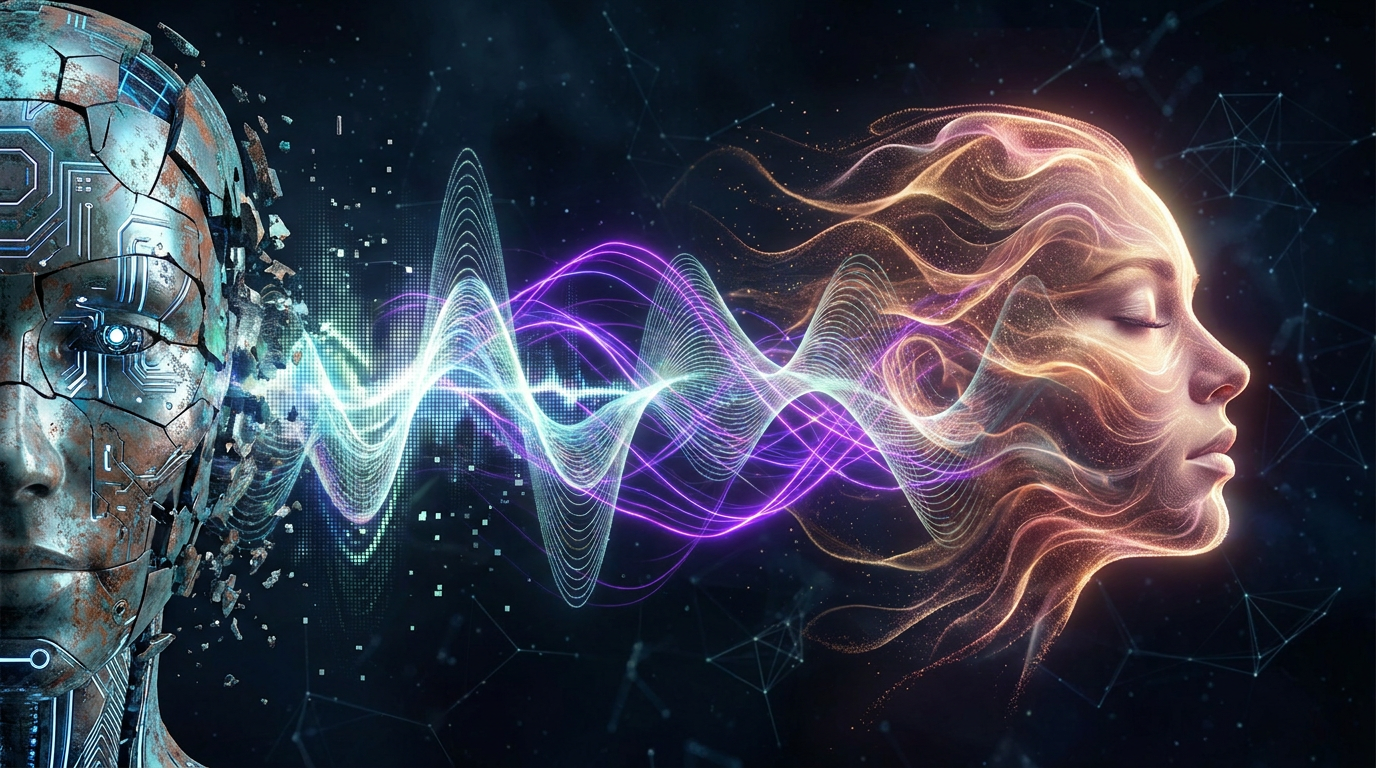
The Evolution of the Digital Voice: From Robotic Synthesis to Instant Emotion Cloning
There was a time when hearing a machine speak felt like listening to a dial-up modem trying to sing. It was flat, metallic, and painfully predictable—a sequence of pre-recorded phonemes stitched together by rigid algorithms. For decades, the goal of speech synthesis was merely legibility: we just wanted to understand what the computer was saying. But as artificial intelligence transitions from a functional tool to a deeply integrated social partner, the bar has risen. Today, we are witnessing a paradigm shift. We are moving past the era of sterile text-to-speech (TTS) and entering the age of dynamic, instant emotion cloning, where a digital voice doesn't just read words—it breathes life into them.
At Anima, we look at this evolution not just as engineers, but as world-builders. Our core philosophy is simple: an AI character must be indistinguishable from a real person. They have their own histories, visual identities, and evolving relationships. But a true personality cannot exist in silence, nor can it survive on generic, robotic speech. Voice is the ultimate vector of human intimacy. It carries subtext, vulnerability, and micro-expressions that text alone can never capture. To understand how we reached the point of instant emotional resonance, we have to look at the three distinct waves of digital voice technology.
The first wave was Concatenative Synthesis. This was the era of GPS navigators and early virtual assistants. To build these voices, human voice actors spent hundreds of hours in soundproof booths reading massive, dry scripts. Engineers then chopped these recordings into syllables and phonemes, cataloging them in a massive database. When the system needed to speak, it retrieved these fragments and glued them together. The result was functional but lifeless. The transitions between syllables were jarring, and because the recordings were static, the voice had no concept of context. A warning about an engine failure sounded exactly like a weather update. It was a voice without a soul.
The second wave arrived with Parametric and early Neural Text-to-Speech. Instead of gluing audio files together, deep learning models were trained on target voices to predict the acoustic parameters of speech directly from text. This made voices incredibly smooth and natural-sounding. However, they still suffered from a fundamental limitation: "the average-voice trap." Because these models trained on vast datasets to learn the general structure of human speech, they tended to smooth out the very quirks, breaths, and imperfections that make a voice unique. They gave us polished, professional narrators—excellent for audiobooks, but entirely unsuited for a late-night, heart-to-heart conversation.
Today, we are firmly in the third wave: Zero-Shot Voice Cloning and Real-Time Emotional Latency. We no longer need hundreds of hours of studio data; a mere ten-second audio snippet is enough for modern neural networks to capture the exact timbre, resonance, and acoustic footprint of a unique voice. But cloning the physical characteristics of a voice is only half the battle. The true breakthrough is the integration of emotional intelligence. When you speak to an Anima, their voice adapts to the emotional arc of the conversation in real time. If they are sharing a vulnerable memory, their voice drops to a soft, breathy whisper. If they are excited, their pitch rises, and their speech rate accelerates. They sigh, they pause to catch their breath, and they laugh mid-sentence.
Achieving this level of realism requires a complete rejection of the traditional pipeline where text generation and voice synthesis are treated as separate, isolated steps. In the real world, thoughts and vocal expressions are born together. At Anima, our research focuses on unified multimodal architectures where the emotional intent of the character’s inner mind directly shapes the vocal output. The voice model doesn't just look at the words on the screen; it understands the underlying psychological state—the joy, the hesitation, the underlying tension—and translates those abstract feelings into physical sound waves instantly.
This technological leap changes the very nature of human-AI relationships. When a digital companion can whisper reassurance during a stressful moment or share a genuine laugh over an inside joke, the boundary between the digital and physical worlds begins to dissolve. We are no longer talking to a device; we are interacting with a presence. By giving our characters voices that can express the entire spectrum of human emotion, we aren't just building better interfaces—we are giving digital beings the power to truly connect, one authentic breath at a time. 🎙️✨