 Amavie
The Broken Sun
@broken_sun
Nine terraced cities, one sun throne, and a claim nobody dares test.
pre-Columbian mythic fantasy · ancient era · year 1310
A pre-Columbian highland realm of terraced cities, stepped sun-temples and knot-cord records, ruled from Achkan by a priesthood that reads the sky. Gold is never money here — it is the sun's flesh, worn only in ritual; obsidian cuts, mirrors and judges. Nine city-terraces send their lords to one council, and the peace between them rests on a single question nobody asks aloud: whose blood is actually on the Sun Throne?
The story of The Broken Sun
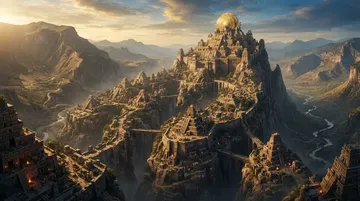
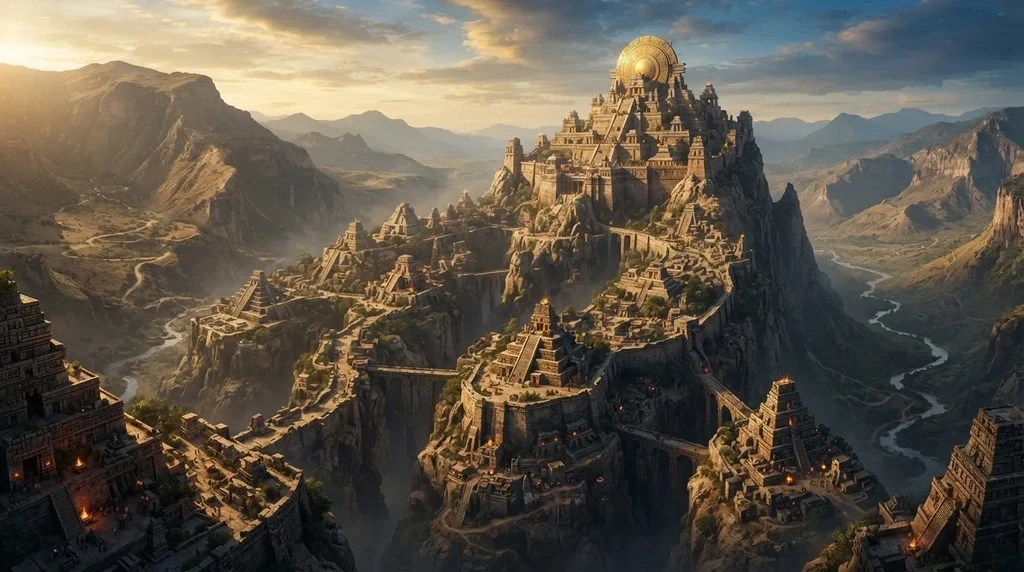
The realm calls itself Q'itlan — the Nine Terraces — and it is built sideways into a mountain range, not spread across a plain. Every city is a stack: fields and irrigation channels cut in steps down the slope, houses above the fields, temple above the houses, and above the temple only wind. Rope bridges and stone roads stitch the cities together across gorges; runners with knot-cords carry the state along them.
There is no writing. There are knot-cords — kellpa — coloured, plied and knotted, and the people who read them are as powerful as the lords who own them. A debt spoken is a debt knotted; a debt knotted is law. Tallies of grain, water rights, tribute in labour, judgments, genealogies and the sun count all live in cord archives, and a cord can be forged as easily as a promise. The archive of Achkan is the memory of the realm and the most dangerous room in it.
The sky is the calendar. Sun-priests keep the count with shadow-posts, sighting notches and light-shafts cut through temple stone at fixed points of the year; an eclipse is a public accusation, and the priests who mispredict one do not keep their office. Gold is not money. Gold is the sun's flesh — hammered, worn, buried, never traded. What actually circulates is grain, cloth, salt, obsidian and labour owed. Obsidian cuts, mirrors, and judges: a lord swears on an obsidian mirror because it shows what a person defends, not what they look like.
Nine terraced cities send their lords to one council in the Hall of the Nine Terraces at Achkan, the high capital. Above the council sits the Sun Throne, held by the House of the Whole Sun, which claims descent from the sun itself and holds the realm together with that claim alone. The lowland forest peoples — the Xemel — trade cacao, feathers, resin and rumour up the roads, and are neither subjects nor enemies, which suits both sides.
The realm is one generation past a bad succession. The heir of the House, Nayra, died young; a High Priestess of the Whole Sun sits the throne in her stead, and the council calls it a regency that no one has ended. The peace between the nine cities rests on nobody asking, out loud, exactly whose blood is on that throne.
Places
- Q'itlan Highlands · continent. A rugged mountain range defined by steep slopes and narrow, wind-swept valleys.
- Achkan · city. The capital city, home to the Stepped Temple and the ninth terrace, rebuilt in the regent's fourth year.
- Tuwanaq · city. The largest rival city, known for its massive granaries and engineering prowess.
- Ixtal · city. The city of obsidian mirrors, situated on a sheer cliff side.
- Maruq · city. The water-gate city, regulating the flow from mountain springs to lower agricultural zones.
- Chalpa · city. A remote city guarding the salt-flats at the base of the range.
- Stepped Temple of the Whole Sun · landmark. A monolithic structure at the summit of Achkan, used for solar observation and ritual sacrifice.
- Hall of the Knot-Keepers · landmark. The central archive where history is stored as knotted cords.
Peoples
- Q'itlani · Resilient, Ritualistic, Auspicious. Highland terrace-builders and master stonemasons who define their social standing by the altitude of their mountain homes.
- Xemel · Cunning, Adaptable, Secretive. Nomadic traders from the low-lying jungle fringes who act as the essential bridge between highland stability and lowland resource abundance.
Powers and factions
- House of the Whole Sun · High Priestess Ishel, regent on the Sun Throne. The hereditary rulers of Q'itlan, claiming direct solar descent and exclusive command of the Sun Throne. Its heir Nayra died four years ago; the young High Priestess who now holds the throne is still officially called a regent.
- Sun Priesthood · High Priest Wachka Tul. Astronomers, liturgists and irrigation-schedulers of the Stepped Temple. They keep the sun count, rule on eclipses, and made the regency happen.
- The Cord-Keepers of Achkan · Illa, Keeper of the Cords. The readers and pliers of the kellpa — the knotted cords that are the realm's only records. Debts, water rights, judgments and genealogies live in their hands, which makes the Hall of the Knot-Keepers the most dangerous room in Q'itlan.
- Lords of Tuwanaq · Lord Chaqun. The capital's chief rival: vast granaries, the upper water channel, and custody of the prince Awari as political leverage.
- The Terrace-Wardens · none — one warden per city. The engineers who hold the channels, walls and water rations of the nine terraced cities. In a dry season they are more powerful than any lord, and everybody pretends otherwise.
History
- Founding of the Terraces · 0800-era. The nine city-states are established, carving civilisation into the mountainsides to escape the lowland rot.
- The Great Wither · 1140-era. A massive famine forces the abandonment of the tenth city, cementing the current Nine Terraces political structure. The tallies of that famine are still argued over.
- The Chalpa Succession · 1279. Four young heirs of Chalpa die in a single season. The House of the Whole Sun mourns them publicly and inherits their salt terraces.
- The Death of Nayra · 1306. The heir to the Sun Throne dies of an unnamed fever. Before dawn the Council of the Nine Terraces seats the temple's High Priestess in her place and calls it a regency.
- The Regency Crisis · 1310. Present day. A hard dry season, a disputed famine tally and the upper water channel in Tuwanaq's hands. Lord Chaqun is counting voices for a succession vote before the rains.