 Amavie
KORM
@korm
They save you while they make you theirs.
post-apocalyptic road-action, social saga, psychological thriller, industrial baroque-punk, a love story about power · post_apocalyptic era · year 2055
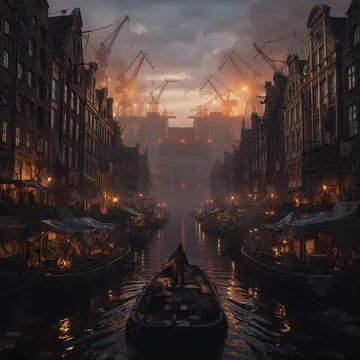
KORM is a post-apocalypse of belonging. The world did not end in one blast: after the White Silence of 2045, when the nuclear chain never completed and no one could prove why, the big systems lost the power to hold water, food, cold, medicine, law and trust at once. About two and a half billion people now live inside whatever still works — kitchens, clubs, cold chains, sleep houses, server cellars, caravans, workshops of masters and the leftovers of the old state. Its gateway is Limen, a post-national port megacity on the northern delta between the North Sea and the Baltic: islands, dams, docks, baroque facades, chemical works and a wet undercity, split into eight sectors and held by clubs, packs and professional circuits rather than by any government. Everyone here is helped, and help almost always has a hidden price. Whoever gives you food, sleep, medicine, a route, a name or love starts to believe they may explain who you are. Korm — the local word for help you cannot live without — buys you a role, and the role turns into belonging. It is 2055. Last year a repairman called Nichey, who only wanted to be left alone, killed a Kamerton messenger, and the Feed made him an event. Now he drives an old emergency-refrigeration van the Feed calls Nobody's, people who refuse to belong gather around him, and someone writes Korm without a name on the walls. Help without capture, love without editing, an exit you can survive — that is what this world keeps asking.
The story of KORM
Korm is the local word for help you cannot live without — and that somebody controls: water, calories, an hour of cold, a bunk for the night, medicine, painkillers, protection, a pass, a confirmed name, access to the Feed, the right to a route, love, the chance to be needed. Whoever holds your Korm sooner or later wants to explain who you are.
HOW THE WORLD BROKE
The world did not end in one blast. From 2026 heat, smoke, floods and failed harvests overloaded every system, and each crisis was still called temporary. Rations, housing, medicine and passes were tied to platform registries and ratings. Then came the corridor wars, the wars of cold and fertilizer, and a biological shift — waterborne infections, mould, resistant bacteria. In 2045 came the White Silence: the nuclear chain did not complete. Launches were cancelled, blocked or never confirmed, and there is no single proven cause — refusing officers, sabotaged command lines, incompatible protocols, the Severers, or a chain of small failures later sold as a great conspiracy. The world was saved from one ending and lost its one head. By 2048 states could no longer hold food, law, army, communications and medicine at the same time, and local nodes began to live on their own. By 2055 about 2.5 billion people remain. The cause matters less than the consequence.
THE NODE WORLD
Countries survive as archive names, languages, ritual habits, ruined borders, military depots, debt papers and memories of order. The everyday map is made of nodes and flows: delta megacities living on water, cold and routes; cold enclaves of pharma, seeds and data; dry caravan belts; agro-domes; archive cities; sea chains. Every place keeps one law — power is visible in who holds the flow and who assigns its meaning.
LIMEN
Limen is a former autonomous port megacity on the northern delta between the North Sea and the Baltic, rooted in old trade leagues, shipyards, chemistry, containers, dams, theatres and migrant quarters. It is no state: it belongs at once to the water, the clubs, the packs, the professional circuits, the Feed and whoever can build a shunt. About 2.8 million people live here, plus 0.4 million seasonal, caravan and unrecorded people; in crisis months up to 0.7 million pass through.
People speak a port creole of North-Atlantic English, Low German, Scandinavian, Baltic and migrant layers; they switch tongues easily and trust…
TH…
Places
- Limen · city. A post-national port megacity on the northern delta between the North Sea and the Baltic: an archipelago of islands, dams, docks, baroque quarters, workshops and wet underground organs. 2.8 million residents plus 0.4 million seasonal, caravan and unrecorded people; up to 0.7 million pass through in crisis months.
- White Day · region. The historic crust: palaces, canals, theatres, courts, galleries and media. Korm: name, publicity, legality. The promise — to be seen and kept; the fear — being erased from the version of history. Scorched stone, old gold, fabric shadows, black water.
- The Machine Arc · region. Workshops, shipyards, chemical works, dormitories, warehouses and repair districts. Korm: work, parts, heat, tools. The promise — work will give you tomorrow; the fear — the line stopping and the skill being lost. Brick, graphite, rails, emergency orange.
- The Dam Throat · region. Sluices, pumping stations, service platforms and the sea passage under the great flood barrier. Korm: water, passage, pressure. The promise — the flow will not stop; the fear — a closed route or a breach. Giant concrete, wet wind, cables, signal lights.
- The Wet Undercity · region. Old metro, pump halls, cold shafts, server cellars and cold storage. Korm: cold, connection, shadow, archive. The promise — it is cool down here and things still work; the fear — water hammer, mould and the current going out. Tile, drips, frost on cables, cold screen light.
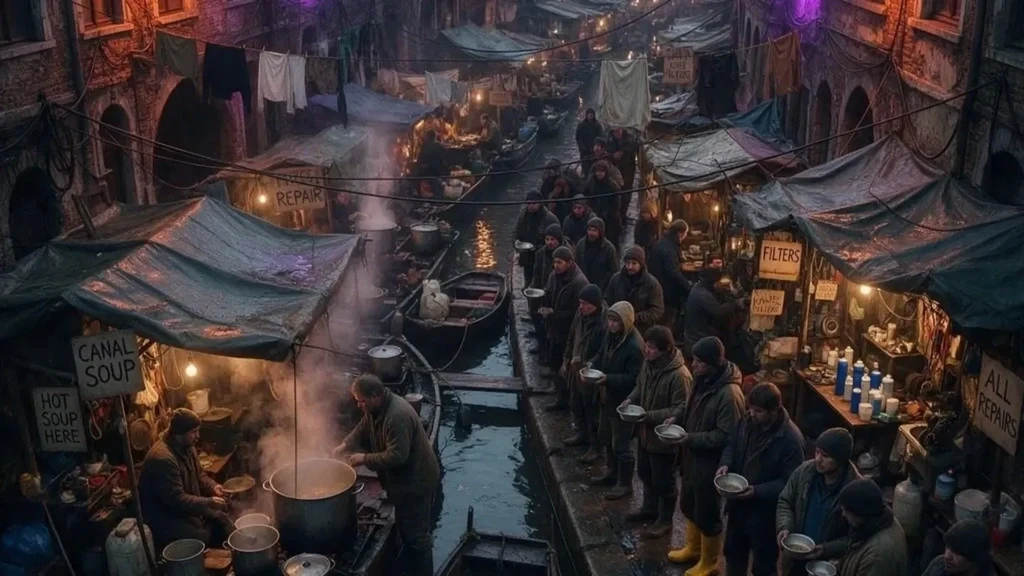
- The Canal Market · region. Boats, barges, bridges, container tiers and the Lower Shelf. Korm: exchange, passage, rumour, forgery. The promise — any exit can be bought; the fear — never paying the deal's true price. Wet awnings, tags, dirty gold, steam.
- The Blind Salt · region. Flooded warehouses, chemical fields, overheated roads and salt houses at the city's edge — the nearest Blind Zone, where maps, signal and status fail. Korm: disappearance, freedom, secret routes. The promise — off the map you can vanish; the fear — dying without a witness.
Peoples
- Normies · routine, discipline, family duty, careful repair, endurance for boring work; the most alarming order is the one that looks almost normal. People used to someone else holding up the big form of life — and the spine of the world: shifts, kitchens, guards, warehouses, sanitary crews and production lines.
- Freaks · improvisation, night work, trust built through style and closeness, tolerance of strangeness, trading in attention; capable of tyranny with a beautiful ritual. Not a race and not a higher species: people who lived beside the main form of life before the collapse — subcultures, DIY masters, radio hams, night workers, couriers, underground medics, artists — and came out of the Seams as the visible interface of survival.
- Circuit masters · competence over speeches, a shared craft language, quiet professional solidarity, the power to sabotage; they know the human price of their procedures. Masters of the city's organs — water, current, cold, kitchen, skin, mesh, name, track, repair, waste, stage, guard. Their professional circuits cut across clubs and packs, and they are stolen, bought, guarded and sometimes made saints.
- Route folk · speed, reputation as currency, blood debts under the law of the route, contempt for maps and centres. Caravaneers, bikers, boatmen, bridge couriers and dam guides who move people and cargo where the map already lies — and who know how to make a person invisible for good.
- Old Order · procedure, old literacy and law, fear of chaos, loyalty to orders nobody may still give. Clerks, judges, archivists, retired officers and keepers of seals left from the old states — legality and procedure without much control over pumps or kitchens.
- The Outside · self-reliance, distrust of lists and names, knowledge of smoke, heat, salt and drowned roads. People of the Blind Zones, where control is weak and survival costs more; they lose only to networks of trust and to a guide who truly knows the route.
Powers and factions
- Kamerton · No one sees it whole; the Top may be a myth. A distributed web of theatre, salon, cipher and fanatic cells that tunes people through invitations, riddles, roles, music and trials. It truly saved people in the crisis — and did not vanish when help became power. To its cells Nichey is a dissonance: the Deaf One, the Zero Note, the man without a part.
- The Shift (pack Tabel) · Vera Tabel. A normie labour club, dormitory and depot with one promise: work your shift and tomorrow will look like today. It feeds and houses thousands and keeps medicine for workers' families; the price is labour debt that passes to your kin.
- The Night Cauldron (pack Pulse) · the cooks and the night stage. Techno club, canteen, boiler house, night church of the hungry and distribution point: no one stays hungry or alone at night. The music never fully stops — silence means an emergency. Vegetables are chopped under the dance floor; workers' children sleep in the quiet rooms.
- The House of Warm Zero (the Zeroes) · the circle of hosts. A sleep house, chosen family and therapeutic stage — the softest form of capture. You can sleep here without waiting for a blow; the price is emotional transparency and the House's right to take part in your decisions.
- Glass (pack Montage). Media club, avatar factory, visibility market and public court: we will make sure you are seen. It does not have to lie — it chooses the angle, the moment and the crop. The price is the right to edit your public version.
- The Dry Rose (Choir of the Rose). Archive gothic, server monastery and mourning salon: we will keep what the world tries to forget — books, maps, medical bases, temperature logs, casts of the dead. The Choir decides which memory is safe and who deserves keeping.
- The Court of Masks (the Masks). Theatre, refuge, market of new faces and masked diplomacy: your old face owes you nothing. Masks, voices, documents and roles hide people from recognition — but the Court keeps your original identity.
History
- The Overheated Normal · 2026. Heat waves, smoke, floods and failed harvests overload utilities everywhere; every crisis is still called temporary. 8.3 billion people.
- Platform Rations · 2030. The first climate lists: rations, housing, medicine, transport and passes are tied to platform registries and ratings.
- The Corridor Crisis · 2034. Export bans, port conflicts, piracy and commodity wars break the corridors of global logistics.
- The Wars of Cold and Fertilizer · 2038. Fertilizer, fuel, antibiotics and refrigerant become military resources; armies, administrations, contractors and platforms receive incompatible orders.
- The Biological Shift · 2042. Waterborne infections, mould and resistant bacteria; medicine starts to fall apart. 5.8 billion people.
- The White Silence · 2045. The nuclear chain does not complete: launches are cancelled, blocked or never confirmed. There is no single proven cause, and the canon names none. The old power showed it would lead people to the edge — and could not explain why the end never came.
- The Loss of Continuity · 2048. States can no longer hold food, law, army, communications and medicine at once; local nodes begin to live on their own.
- The Node World · 2052. Clubs, circuits, packs, old powers and caravans build the new order: real power belongs to whoever holds the water, the cold, the list, the route, the bunk and the Feed.