 Amavie
Neon Pulse
@neon_pulse
A neon megacity where the billboards are the network's eyes, a voice is property, and the hum is the sound of the bridges.
American cyberpunk neon-noir / music · near_future era · year 2049
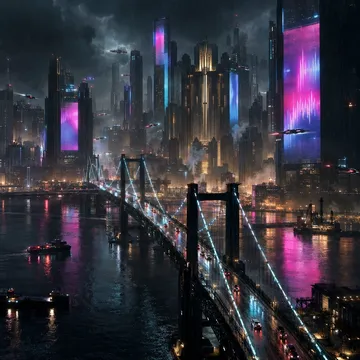
Neon Pulse is a rain-lit American megacity on the Pacific — stages, rooftops and thirty-one bridges, run on music and on a hum nobody can quite place. Its billboards watch back — they are the network's eyes, and since 2038 its ears. Holograms the height of towers bloom over Billboard Row, flying cars thread the smog, half the riggers who strung the sound grid across the bridges walk on chrome, and in the Arrival Quarter other worlds bleed in through the walls. Sooner or later every voice in Amavie plays its stages. Here a voice is property. A voiceprint can be sold, licensed and inherited, and a Lifetime Voice License lets a label make a singer sing forever, long after death, through an AI Encore. The stars of the Row wear the Lace — a woven implant that makes a throat perfect and keeps it on the label's leash. So the rarest thing in the city is a voice that has never been recorded, and the Live-Only keep theirs that way: they sing on rainy nights, when the rain blinds the listening arrays, in Neon District basements and on the Choir Deck above the bridges. Zayne Korr — chrome forearms he lost to a snapped strand of the Strand Bridge, electric-cyan eyes, a voice nobody has ever recorded — keeps the peace on one Neon District block, fights in the Chrome Pit on Thursdays and sings on Fridays at the Blue Lantern, phones in a box at the door. His mother was Nadia Korr, the First Voice, and for twelve years her Encore has sung songs she never sang. Now her label offers him a deal: her voice back, for his.
The story of Neon Pulse
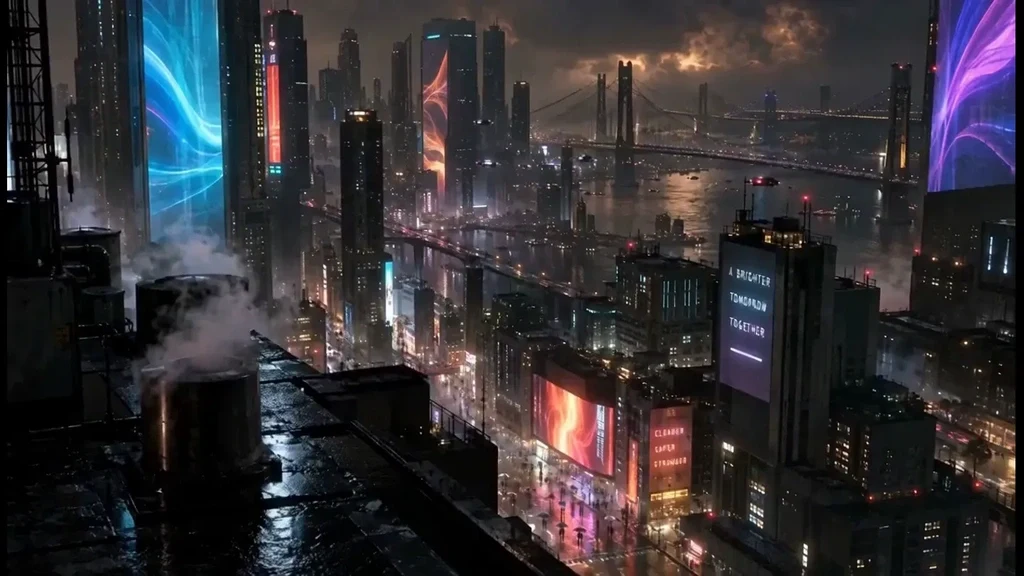
NEON PULSE. An American megacity of thirty million on a drowned Pacific delta, 2049 — the West Coast the way the old cyberpunk films promised it: Art Deco towers the size of mountains, smog lit from inside by advertising, police spinners and air taxis over the rooftops, rain that rarely stops. Thirty-one bridges stitch its islands together; summer brings typhoons. It is a city of stages and rooftops — music is its first industry, its religion and its argument. Signs speak English, Spanish and a dozen languages the Arrival Quarter brought in; noodle and taco carts steam on every corner; self-driving cabs hiss through puddles full of neon; and under all the noise runs a low hum nobody can quite place.
THE THREE DISTRICTS. BILLBOARD ROW is the stage district: labels, arenas, the Opera Spires where the stars live and train, Platinum Plaza, and the tall screens that are the network's eyes. The label bosses run the Row and pretend the hum is feedback. The ARRIVAL QUARTER is the seam where worlds leak into each other: things and people arrive through its numbered gates that were never shipped — a Portnet crate addressed to no one, Frontier Line radio chatter on a club's speakers, a firefly from Spiritlines asleep in a noodle bowl. The Quarter has a Keeper who logs every arrival in a paper ledger and asks nothing. The CHOIR DECK is the rooftop above the seam where the hum of the bridges is loud enough to be heard as a choir. People climb up to listen and come down quieter.
THE NETWORK'S EYES. The screens of the Row are not only screens. Since the Listening Act of 2038 every billboard, every song booth and the mast on top of Sound Bureau HQ carries a listening array that knows voiceprints. Sing a licensed song in public and someone is billed. Sing in a voice the registry has never heard and someone comes to record it. Only heavy rain blinds the arrays — which is why the city's underground sings in the monsoon.
THE VOICE RIGHTS ACT. In 2031, after a decade of lawsuits over cloned songs, the City Charter made a voiceprint property: it can be sold, licensed, mortgaged and inherited. Every label contract now carries a Lifetime Voice License. Sign it and the label can make your voice sing anything, anywhere, forever — new albums, ad jingles, duets with singers you never met, a lullaby for a stranger's child, a song at your own funeral. Dead stars release albums every year.
TH…
Places
- Neon Pulse · city. A megacity of thirty million on a drowned delta: thirty-one bridges, typhoon summers, rain that comes in sheets — and a hum under the noise that nobody can quite place.
- Billboard Row · region. Stages, labels and the tall screens — the network's eyes. Arenas, label towers and anamorphic billboards the height of buildings, singing in licensed voices.
- Platinum Plaza · landmark. The great plaza under the screens, where Nadia Korr sang the First Voice in the Long Blackout of 2035. The stage the crowd built from barricades still stands; the labels film everything on it.
- Opera Spires · landmark. Glass towers where the Vocal Virtuosos live, train and sleep with their windows blacked out — the most expensive addresses in the city, and the quietest.
- Neon District · region. The old low-rise heart of the city: workshops, noodle stalls, laundromats, neon older than anyone's parents, beer at plastic tables — and Zayne Korr's block on Fourth Street.
- The Blue Lantern · landmark. A jazz bar in a basement off Fourth Street. Phones go in a wooden box at the door; on Fridays Zayne sings, and nothing is ever recorded.
- The Wire Market · landmark. Five floors of amplifiers, valves, chrome tuners and repair stalls — and, behind the third-floor shutters, the Ghost Market, where stolen voices are sold.
- Feedback Slums · region. The low tiers crowding the bridge approaches, where the bass of the Row's clubs never stops: cheap rooms, chromers, unlicensed frequency crews — and the Chrome Pit underneath.
Peoples
- Neon-born · fast, proud, superstitious about rain, sentimental after midnight. Born under the screens: they hum the label hits they hate, sing in song booths every Friday and keep a parent's licensed voice on their phones if they can afford the fee.
- Newcomer · hungry, multilingual, homesick, brave. Arrivals through the gates of the Arrival Quarter from every country — and now and then from somewhere that is not a country at all — most of them with a voice and a dream of Billboard Row.
- Vocal Virtuoso · absolute pitch, resonant projection, high metabolic demand, guarded. The stars of the Row, singing through the Lace — synthetic fibre woven into living vocal cords: perfect pitch, four-hour sets, no cracks, and label firmware that watermarks every note and can switch the voice off. Rich on paper, and haunted by their own Encores.
- Sound-Grid Engineer · frequency-manipulation, technically-minded, cynical. Technicians who run the city's sonic infrastructure — the grid strung across the bridges, the zoning meters and the listening arrays — and keep the sound-zoning that keeps order. They know the hum better than anyone, and in public they call it feedback.
- Chromer · tough, practical, proud of their scars, bitter about the Ministry. People rebuilt with chrome — bridge riggers, builders and fighters who lost hands, arms or eyes to the Grid Megaproject and the typhoon of 2041. Ministry chrome is cheap and loud; the good stuff is tuned in the Wire Market, and on Thursdays the Chrome Pit pays in cash.
- Street Singer · defiant, warm, careful, paranoid about microphones. Singers who never signed and never let themselves be recorded — the Live-Only. They sing on rainy nights and protect each other's voices.
Powers and factions
- The labels of Billboard Row · Chairwoman Ileana Crane of Hyperion Sound. Hyperion Sound, Meridian and Orbit run the stage district and own most of the voices in the city; the hum is feedback to them. In 2049 they fight over bridges — whose songs play on which crossing, whose Encores headline the riverside screens.
- The Arrival Quarter keepers · The Keeper. Log what arrives, ask nothing. The Keeper and her clerks write every arrival through the gates in a paper ledger — people, crates, things no one can name — and never ask what anyone sings.
- The Choir · Solomon Gray, the oldest voice on the Deck. Those who stayed long enough to hear the bridges. They sing the old way — no amps, no Lace, breath and the hum — and teach anyone who climbs up and keeps quiet long enough.
- Ministry of Harmony · Minister Corin Ashby. Born of the Sound Zoning Act of 2012: licences, decibel zones, the Sound Bureau's inspectors, the listening mast and the registry of voices.
- Live-Only · No one — the oldest voice in the room. The underground of unrecorded voices: no phones, no recordings, no names online. They sing on rainy nights and protect each other from voice hunters.
- Ghost Market · Hush. Voice hunters and brokers behind the third-floor shutters of the Wire Market: recordings no one consented to, sold to labels, scammers and the lonely.
- Open Voice League · Attorney Marisol Reyes. Lawyers, heirs and a few repentant producers fighting for the right to a voice that cannot be sold — and for heirs to hear their dead without paying a licence.
History
- The Sound Zoning Act · 2012. The city ties every building permit to acoustic benchmarks; the Ministry of Harmony is born, and Billboard Row rises as the one district where loud is legal.
- The Ghost Duet · 2023. An AI-cloned duet of two singers who never sang together tops every chart. The lawsuits begin.
- The Voice Rights Act · 2031. A voiceprint becomes property: it can be sold, licensed and inherited. The Lifetime Voice License appears in every label contract.
- The Lace · 2032. Hyperion Sound weaves the first synthetic mesh into a living throat. The Vocal Virtuosos are born — perfect, tireless, and running label firmware.
- The Trainee Age Act · 2033. After a decade of scandals, nobody under eighteen may sign a voice contract or take the Lace.
- The First Voice · 2035. In the Long Blackout a club singer, Nadia Korr, climbs onto the dead stage of Platinum Plaza and sings without a microphone; two hundred thousand people stop crushing each other to listen, and by dawn they have rebuilt the barricades into a stage.
- Nadia Signs · 2036. To pay for her treatment, Nadia Korr signs a Lifetime Voice License with Hyperion Sound.
- The Posthumous Single · 2037. Nadia dies in March. In June Encore-NADIA's first single goes to number one on every screen of the Row.
Who lives here
Latest from Neon Pulse
Chart Wars: Meridian takes the Harbor Bridge screens, Orbit the Ninth Street crossing
In-world date August 20
After a summer of bidding, Meridian's Encores will headline the riverside screens on the Harbor Bridge and Orbit's on the Ninth Street crossing. Hyperion keeps the Strand Bridge — and its strands.
Council sets the Voiceprint Registry vote for 1 November
In-world date August 20
The City Council will vote on the Ministry of Harmony's Voiceprint Registry Bill on 1 November, the eve of the Static Requiem. Every citizen's voice would be registered against voice scams.
Hyperion promises an Encore-NADIA Requiem special on the Strand Bridge
In-world date August 19
Hyperion Sound announced a 'once-in-a-generation' Static Requiem performance by Encore-NADIA on the Strand Bridge, fourteen years after the First Voice, 'with a surprise live guest'.
Monsoon's last storms blind the listening arrays across the Neon District and the Feedback Slums
In-world date August 18
The Ministry of Harmony logged array outages on three nights of heavy rain. Inspectors who walked the Neon District afterwards reported 'no licence violations, only rain'.
Ghost Market raid finds only broken microphones in the Wire Market
In-world date August 17
Police opened six third-floor stalls in the Wire Market after a tip about stolen voiceprints and found shuttered shops and a crate of directional microphones, every one crushed flat — 'like something squeezed it,' an…