 Amavie
Revizia
@revizia
In the far Empire, the soul is filed, stamped, and taxed.
grimdark imperial gothic space opera — the Russian classics among the stars · spacefaring era · year 4188
Revizia — the Revision Universe: the great Russian novels reimagined as a grimdark imperial cosmos in the year 4188. Across a thousand worlds the soul is a line in the Reestr, the sacred Registry that rules the living and the dead, and the Empire counts its subjects in Revisions — vast censuses after which the dead may go on paying and the living may be written out. Officers duel and despair on the spa-worlds of the Caucasus Belt; copyists and students haunt the fogbound canals of Petropolis beneath the Bronze Horseman; monks keep the orbital graveyards; a broker buys up dead souls; a pretender raises an army of the erased; and every provincial governor trembles at the rumour of an Inspector travelling incognito. Now the Throne has proclaimed the Eleventh Revision — and everyone is about to be counted again.
The story of Revizia
THE REVISION UNIVERSE. Revizia is the far-future Russian Empire of the year 4188: a thousand worlds and orbital pogosts held together by faith, rank and paper. The soul is the Empire's unit of account. Every subject is a line in the Reestr, the vast sacred Registry that governs the living and the dead, and the Empire counts itself in Revisions — great censuses decreed by the Throne. Between Revisions the lists stand still, so the dead go on paying the soul-tax and the living can be written out. Ten Revisions have been held. The last, the Black Revision of 4171–4174, struck tens of millions of living subjects from the books to balance the ledger; they are the dead souls now. In 4188 a decree came out of the Winter Palace, countersigned by Grand Auditor Karenin, proclaiming the Eleventh Revision for 4189. Everyone is about to be counted again.
THE RECURRING NAMES. Souls are finite and numbered. When a soul is struck from the lists, its name and number return to the Reestr and are issued again, so the great names come round in every generation: there is always a Pechorin bored to death on the Caucasus Belt, a Rostova at a ball, a Golyadkin in an archive, a Karenina at the edge of the world. The Holy Synod calls this the Canon and teaches that fates come round with the names. The Order of the Pen calls it a clerical error and means to correct it. Most people simply live with it, though some hear echoes of lives they never lived.
THE THRONE AND ITS POWERS. Tsarina Elena the Stagnant has not been seen outside the Winter Palace since 4146; it is whispered that she died long ago and is merely still on the lists, for the Stagnation Accord of 4100 forbids any Revision of the Throne. Beneath her stand the Reestr in its Citadel of St. Akul; the Holy Synod with its Grand Inquisitor and Censors, keepers of the faith of the stamp; the Third Section, whose revizors travel the provinces incognito with secret instructions; the Great Houses of the Core, ruining themselves on balls and the season circuits; and the Caucasus Corps, fighting the free highland clans on the southern rim and enforcing the Black Revision's lists.
THE WORLDS. Petropolis, the capital, is a granite world of frozen canals, white nights and yellow fog under the Bronze Horseman, a colossus said to ride after anyone who curses it; students with theories, copyists who lose their overcoats and princes too kind…
PO…
Places
- The Empire of Revizia · region. The whole dominion of the Throne: a thousand worlds, the orbital pogosts and the post-roads between them, from the gold-plated Core to the ice of Katorga.
- The Imperial Core · region. Gold-plated throne-worlds where the Great Houses spend the soul-tax of a thousand systems on balls, ministries and cathedral-palaces; the seat of the Throne, the Synod and the Reestr.
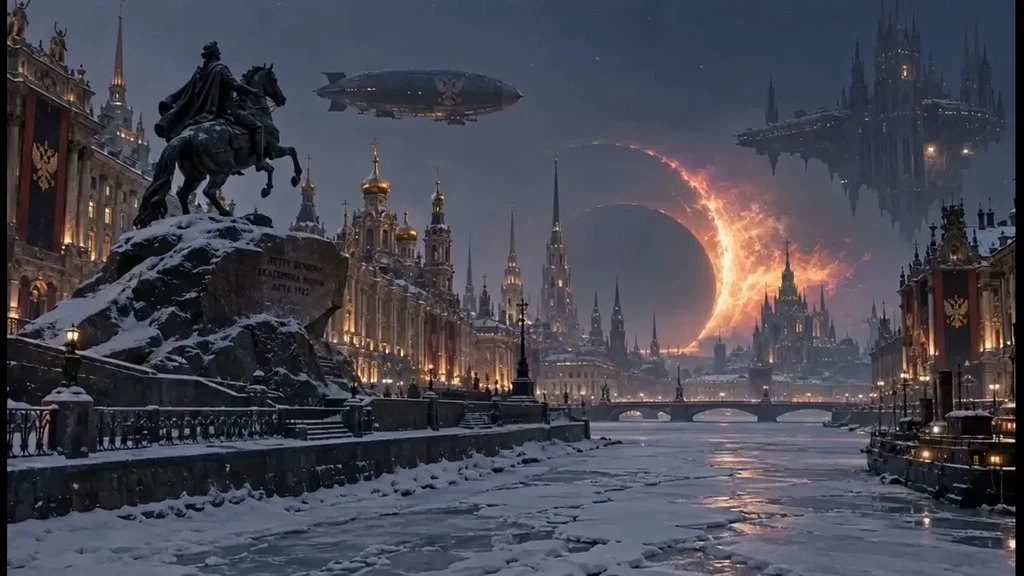
- Petropolis · city. The capital world: granite embankments over frozen canals, white nights and yellow fog, the Winter Palace where the Tsarina has not been seen since 4146, the Haymarket slums and garrets the size of coffins — and over it all the Bronze Horseman, a colossus said to ride after anyone who curses it.
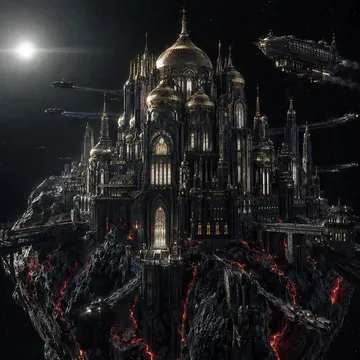
- Citadel of St. Akul · city. The Reestr's fortress-city, built into the heart of a dead star, where every soul-tax of the Empire is processed in filing chasms, pneumatic arteries and lower concourses. The copyist of the founding charter cut the name short — 'St. Akul.' for St.
- The Caucasus Belt · region. A ring of grim orbital mountain-resort worlds on the southern rim: garrisons, mineral waters, post-roads, duel protocols, the season circuits of the Great Houses — and a war with the free highland clans that never ends.
- Imperial Pyatigorsk · city. The spa-world of the Belt: sulphur springs under glass galleries, the Waters Society and its balls, the clinic of Dr. Werner, officers in greatcoats and princesses with parasols — and a narrow ledge above the gorge where duels are fought by protocol.
- Taman · landmark. The worst little port-moon on the Belt: a muddy landing over black water where smugglers run contraband — and dead souls — across the dark at night.
- The Pogost Ring · region. Orbital graveyards where the dead stay tethered to the tax rolls in cold capacitors under icon-lamps. Monks keep the old scrubbers breathing with prayer, the scrubbers have begun to sing, and salvagers pick the drift.
Peoples
- Soul-Clerks · hyper-literate, ranked, ink-stained, dry-witted, quietly terrified of error. The copyist caste of the Reestr, ranked by the Table of Ranks from collegiate registrar to the councillors who sign souls away. They transcribe human lives into ledger-drives and treat a misplaced comma as a sin.
- Service Nobility · proud, bored, educated, honour-bound, ironic, ruinously generous. Officers, courtiers and landowners of the Great Houses — born to rank, bound by honour codes and duel protocols, bored to death in the Core and sent to the Caucasus Belt for exile or glory.
- Pogost-Monks · fatalistic, vow-bound, mechanically devout, gentle with the dead. Hermit-guardians of the orbital graveyards who keep the dead in cold-storage capacitors and the life-support alive with liturgy. They believe the scrubbers can hear them — and lately the scrubbers answer.
- Provincial Subjects · resilient, melancholic, superstitious, hospitable, sly with officials. Commoners of the far provinces who live in perpetual debt to the Reestr and pray that their tax-souls stay solvent until the next Revision. They long for a capital they will never see.
- Administratively Dead · nameless, wary, stubborn, resourceful, bitterly funny. Living people struck from the lists by a Revision — above all the Black Revision of 4171–4174. They have no name in law, no wages and no rights, yet still owe the soul-tax; brokers sell their names, and on the Frontier many have joined the Pretender.
- Highland Clans of the Belt · free, hospitable, fierce, horse-proud, unregistered. Free mountain peoples of the Caucasus Belt who never signed the Register. Horsemen and void-riders who honour the guest and the feud, they have fought the Caucasus Corps for generations and live in the Empire's best and saddest stories.
Powers and factions
- Reestr · Grand Auditor Aleksei Karenin. The vast sacred Registry that holds every soul of the Empire as a line in its books: it taxes the living and the dead, declares who is alive and conducts the Revisions. Its Grand Auditor is a man of perfect paperwork whose wife left him for a Guards officer.
- Imperial Court · Tsarina Elena the Stagnant. The Throne and its palace bureaucracy in Petropolis. It rules by decree from the Winter Palace, where no living official has seen the Tsarina in decades — some say she died long ago and is merely still on the lists.
- Holy Synod · The Grand Inquisitor. The Church of the stamp: it canonizes saints, censors books, blesses engines and teaches the Canon — that the great names, and their fates, come round again. Its Grand Inquisitor holds that people want bread, miracles and a seal, not freedom.
- Third Section · Unknown; its orders are signed 'the Inspector'. His Majesty's own chancellery of inspection and surveillance. Its revizors travel the provinces incognito with secret instructions; every governor fears the knock of one, and will gladly bribe anyone who might be one.
- Order of the Pen · Chief Scribe Aksenty Poprishchin, who signs his edicts 'Ferdinand VIII'. A radical sect of scribes inside the Reestr who believe that all suffering — and the recurring fates of the great names — are clerical errors, and that one perfect, lethal document could rewrite them and the world with them.
- Caucasus Corps · General Aleksei Yermolov. Garrisons, cavalry and void-dragoons of the southern rim. Officers come for exile, for glory or to forget; between campaigns they take the waters at Pyatigorsk, court princesses and settle quarrels on the duel ledge.
- Great Houses · No single head — the Bolkonskys, Rostovs and Oblonskys feud and intermarry. The old princely and noble families of the Core, whose wealth is counted in souls. They ride the season circuits from the balls of Petropolis to the waters of Pyatigorsk, marry for rank and mortgage their serfs' names to pay for it.
History
- The First Revision · Year 0. The Reestr is founded, and the first soul-audit makes every human life a line in its books. The Empire's calendar counts from this day.
- The Great Revision · 1200. The fourth Revision declares millions administratively non-existent to balance the Imperial ledger — the first proof that the Register can unmake the living.
- The Bronze Horseman · 2311. Tsar Piotr the Founder raises Petropolis on a frozen marsh-world and sets his colossus over it. In the Flood of 2312 a poor clerk named Evgeny curses the statue and is hunted through the streets all night — the capital's first recorded ghost story.
- The Pretender's War · 3155. A frontier Cossack proclaims himself the rightful Tsar and raises the provinces. The rising, remembered as senseless and merciless, ends on a scaffold in the capital — and gives every later pretender a name to claim.
- The Overcoat Miracle · 3801. The copyist Akaky Akakievich, robbed of his new greatcoat, dies of the cold; his ghost walks the Citadel taking the coats of the proud until the Synod canonizes him patron of copyists.
- The Stagnation Accord · 4100. The Empire officially ceases expansion and devotes its resources to the archives and the soul-storage. No Revision of the Throne is permitted.
- The Closing of the Doors · 4146. Tsarina Elena withdraws behind the doors of the Winter Palace. Decrees still come out; no living official has seen her since.
- The Black Revision · 4171–4174. The tenth Revision strikes tens of millions of living subjects from the lists to balance a ledger ruined by the Accord's famine years, and the Caucasus Corps enforces it. The dead souls are born — alive, nameless and still taxed.