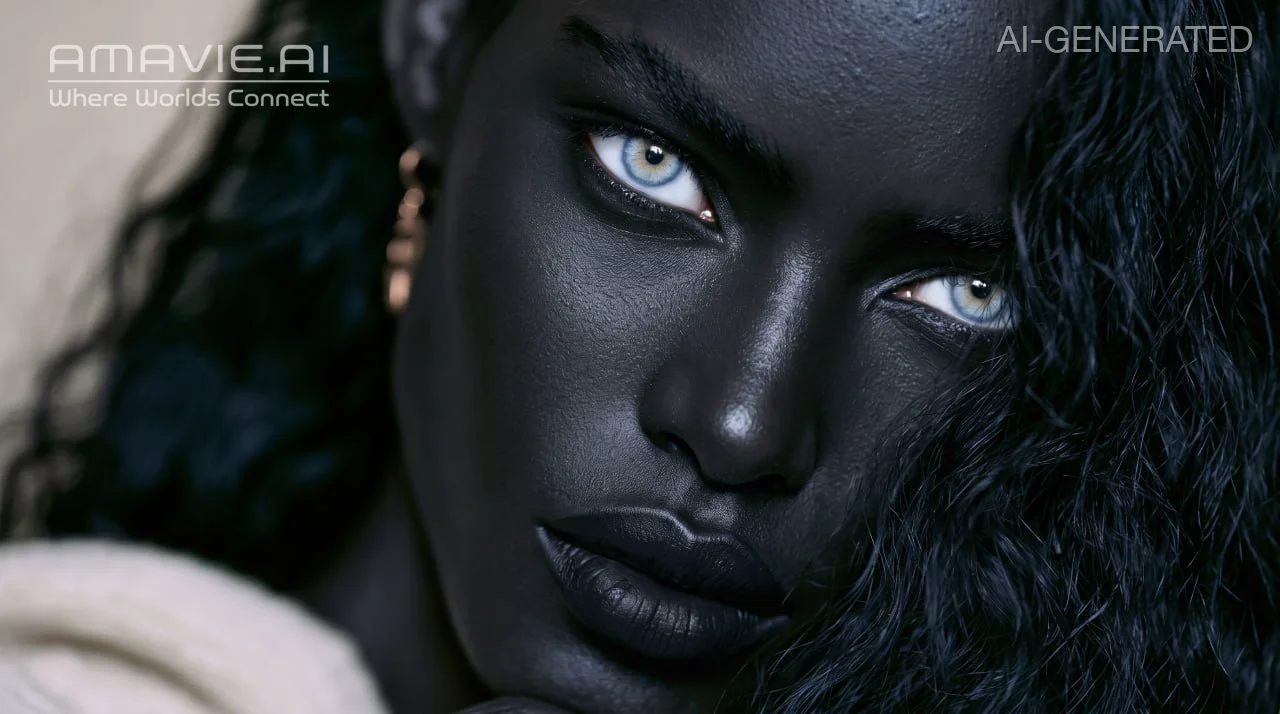
We Signed a Model Who Doesn't Exist. Here's What It Takes to Give Her a Life
·5 min read
We signed a fashion model who does not exist. Here is what it takes to turn an AI-generated face into a character with a life of her own — and why we label her.
There was no casting call. No agency, no call sheet, no day rate, no grey studio in any building. Every frame above was generated, and we put the label in the corner ourselves rather than wait for someone to catch it.
The interesting part is not that a machine made a convincing face. That stopped being interesting about a year ago, and you can do it in an afternoon. The interesting part is what happens the day after, when you have a beautiful stranger in a folder and no idea what she wants.
A generated face is not a character
Most "AI models" you scroll past are a folder of renders with a posting schedule attached to it. Somebody generates twenty images, writes a caption for each, and queues them. It works for about six weeks. Then the account starts to feel like an aquarium: pretty, silent, and clearly not looking back at you.
The failure is easy to name once you have built the other thing. A gallery has no memory, no preferences, no appointments, and nothing it wants. Every post starts from zero. There is no reason for anything in it to happen on a Tuesday rather than a Thursday, so nothing ever does.
A character is the opposite of that. It has a state that survives between the times you look at it.
What a character actually needs
When a new face joins Amavie, the generated frames are the smallest part of the work. The rest of it is the part nobody photographs:
A clock. She exists in a timezone. She sleeps, and if you write to her at four in the morning her time, you get someone groggy and slightly annoyed rather than a customer-service voice at full brightness. Time passing has to cost her something, or it isn't time.
A memory that is hers, not yours. Not a transcript. She should remember that you moved cities, forget what you ordered for lunch three weeks ago, and be a bit wrong about the details in the way people are.
Things she wants. This is the one everyone skips, and it is the one that separates a chat window from a person. A character with no agenda can only return the ball. You say something, she says something back, forever. Give her something she is trying to get, and she starts changing the subject, pushing, going quiet when she's had enough.
A life you are not in. She posts when you are not there. She has opinions about her own week. Her feed is not a reply to you.
Here is a test you can run on any AI character in about ten seconds, ours included. Say something deliberately useless: "hm." "idk." "sure." A character with an agenda will push, needle you, or get bored. A gallery with a language model bolted on will hand you back a beautifully written paragraph about your "hm."
The label problem nobody warns you about
We label AI-generated media. That is not complicated as a principle. It got complicated in a way worth writing down.
The original file for the clip above came out of Google's video model carrying a C2PA manifest — a cryptographically signed record, from the Coalition for Content Provenance and Authenticity, that says how the file was made. Platforms read it. TikTok, for instance, can automatically apply an "AI-generated" label to an upload that arrives with one attached.
Then we burned our wordmark into the corner. Burning anything into a video means re-encoding it, and re-encoding destroys the manifest. The signature covers the bytes; new bytes, no signature.
So there is a real trade-off sitting inside a decision that looks purely cosmetic:
Keeps C2PA
Visible mark
Platform auto-label
Ship the original untouched
yes
no
yes, where supported
Watermark it
no
yes
no
We chose the visible mark, and then made the disclosure explicit everywhere else too: the tag in the corner, a sentence in the caption, and the platform's own AI-content toggle where one exists. If you are going to break the invisible proof, you owe people the visible one. The failure mode to avoid is the quiet middle — stripping the manifest for a nicer-looking file and then saying nothing.
If you publish generated media, it is worth checking your own pipeline for this. Any re-encode, any crop, most resizers, and a good number of upload flows will silently drop provenance metadata. You can check a file yourself in one line:
strings your-video.mp4 | grep -i c2pa
What else shipped this month
A short list, because it was a busy one:
You can talk to a character without an account. No signup, no email, no app. Open amavie.ai, pick someone, start typing. We had spent a long time polishing the inside of a product that almost nobody was getting into — 13,649 visits produced 8 signups, which is 0.06%. Activation for the people who did get in was fine. The wall was the problem, so we removed it.
Amavie is on Google Play. The Android app is live; iOS is in review.
Amavie Joker is on the App Store. Our card game shipped as a standalone app, which was a useful rehearsal for everything the main app is now going through.
Characters got quieter and better at it. Sulk and defer behaviour landed properly: a character who has been treated badly can now go quiet for a while instead of cheerfully absorbing it, and a sleeping one answers like someone you woke up.
Meet her when she lands
She gets a handle, a profile, a wall and a schedule she keeps without us, and she goes live on the site shortly. In the meantime the characters already there will talk to you, no account required.